
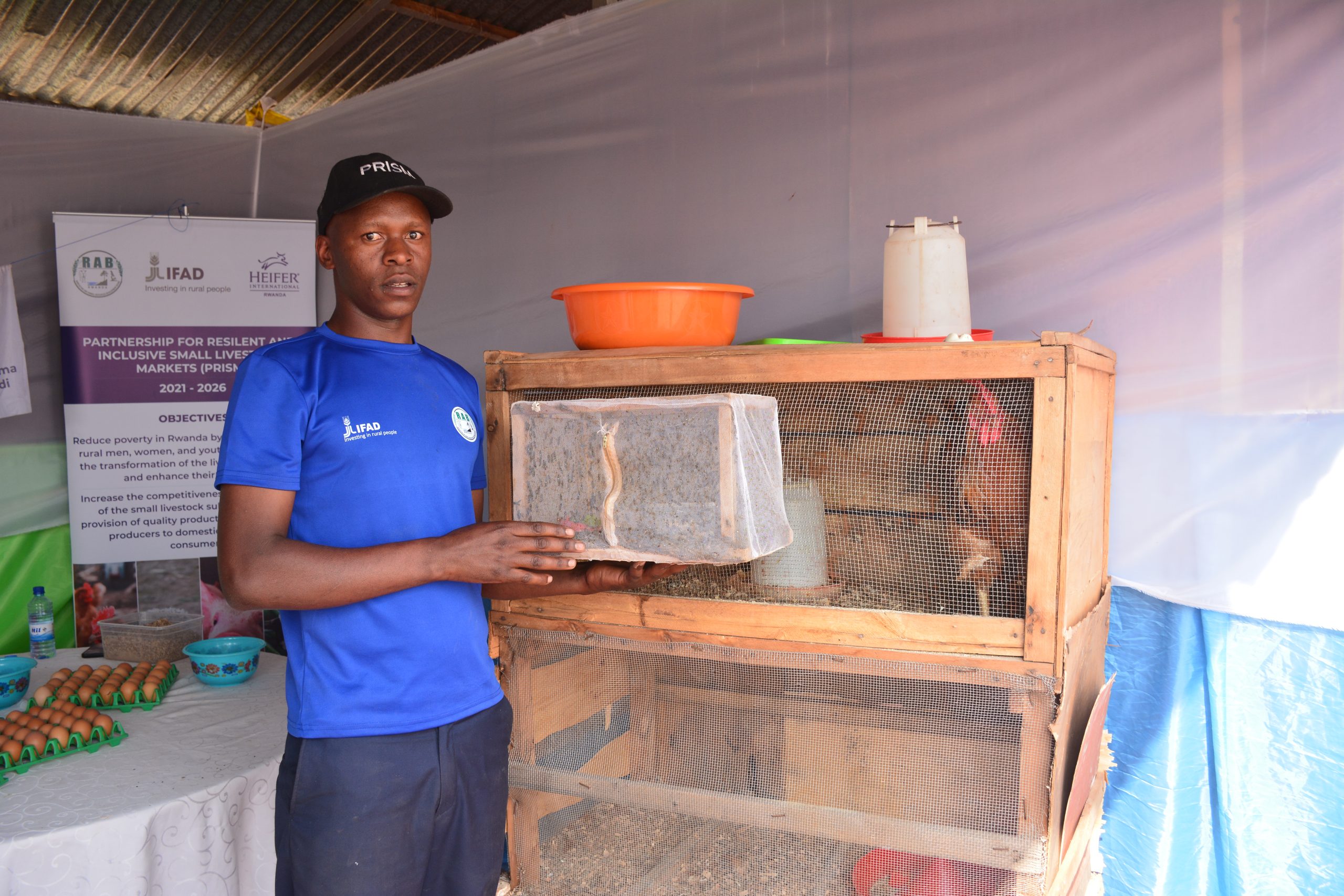
In Byumba Sector, Gicumbi District, Uzabakiriho Alphonse runs a small and growing animal feed production facility where he makes feed using black soldier flies (Black Soldier Fly). His goal is to help farmers in his community reduce the cost of animal feed.
The idea of producing animal feed did not start immediately. Alphonse says he first started rearing black soldier flies after looking for a solution to the high cost of animal feed, especially for poultry farmers in his area.
Through the Partnership for Resilient and Inclusive Small Livestock Markets (PRISM), a project implemented by the Rwanda Agriculture and Animal Resources Development Board (RAB) through the SPIU of IFAD-funded projects, and supported by the Government of Rwanda, Alphonse later received support that helped him start producing animal feed.
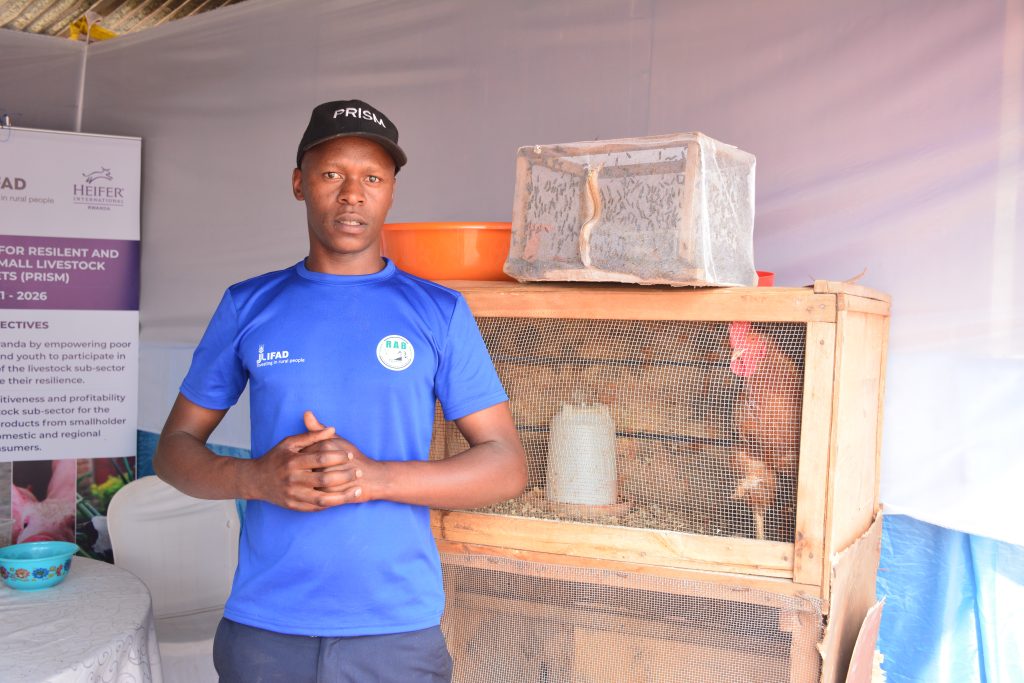
He says PRISM first provided him with two pigs and feed to support him in starting livestock farming. When the feed provided was finished, the project advised him to start making his own animal feed using black soldier flies. He was also given starter black soldier fly stock and trained on how to rear them.
Today, Alphonse produces animal feed on a small scale, but his work is helping farmers around his community. He says he can produce at least 50 kilograms of animal feed per day and about 300 kilograms per week. When he produces the feed himself, one kilogram costs him about 300 Rwandan francs.
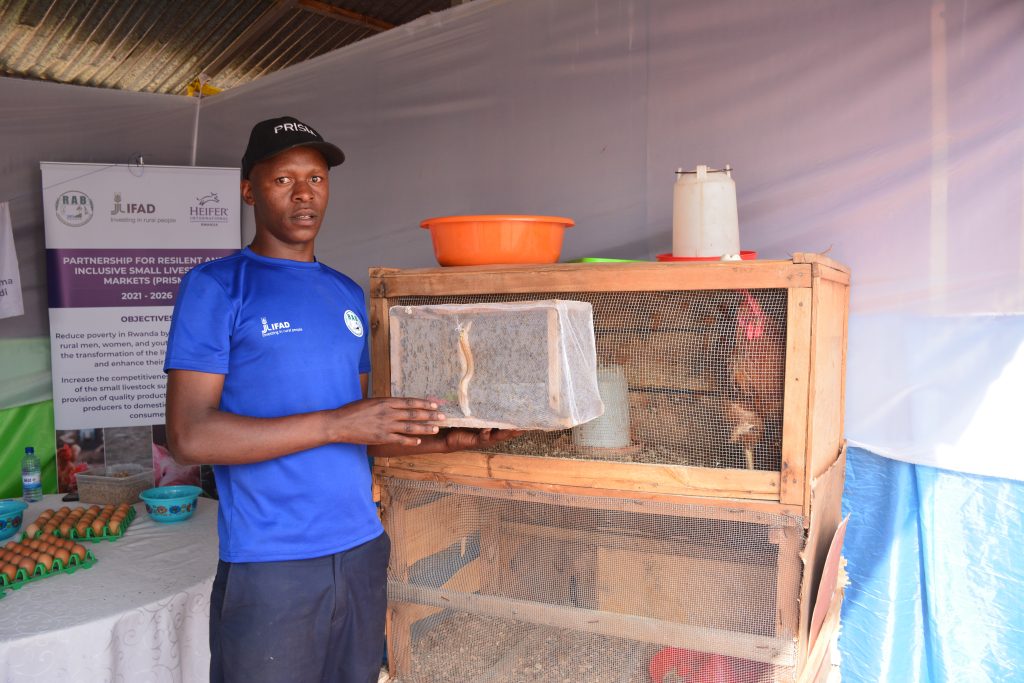
The feed is made from black soldier fly larvae. Alphonse explains that the process starts by placing fly eggs in organic waste. After about 15 days, the eggs develop into larvae, which are then dried and processed into insect meal used to make animal feed.
“To produce 50 kilograms of animal feed, I use 12 kilograms of insect meal and add 30 kilograms of maize,” he says.
He adds that the mixture also contains one kilogram of lime, one kilogram of bone meal and vitamins. The final product is mainly used to feed chickens.
Alphonse also uses Azola, a plant grown in water, as part of his feed production process. He says he can produce about 50 kilograms of Azola per week, which helps him improve the animal feed he makes.
Besides animal feed, he also produces organic fertilizer from black soldier flies. He says the fertilizer has a nutrient value of 2-5-2 and is rich in potassium. One kilogram is sold at 100 Rwandan francs, and he can produce one sack per day.
Although his production is still small, Alphonse says his facility can help supply animal feed to farmers in his village and provide an alternative to expensive commercial feeds.
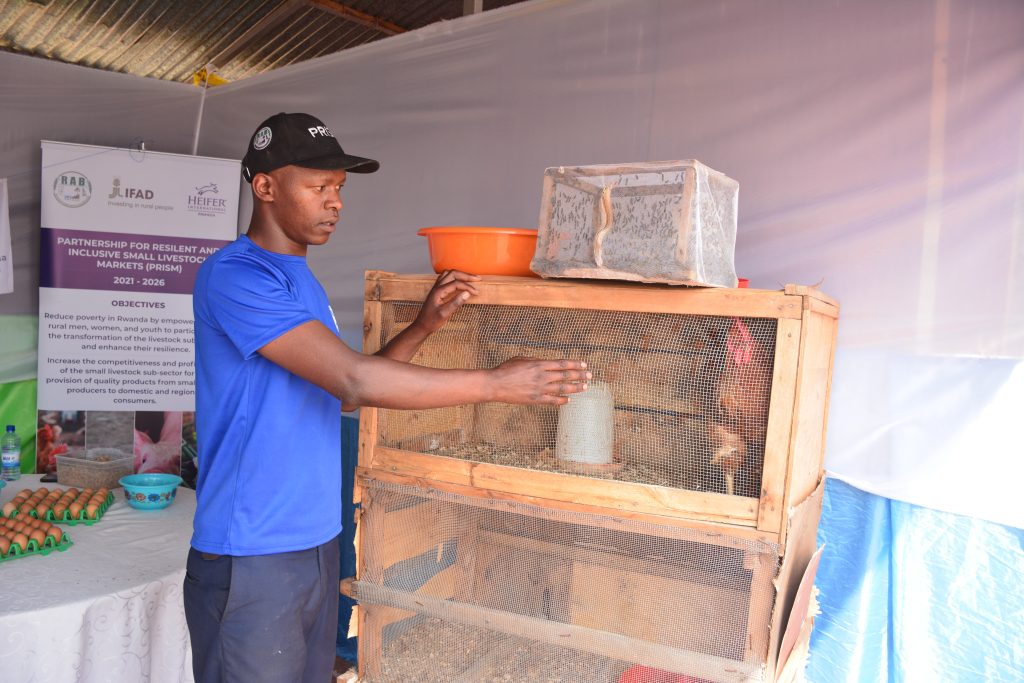
During an RwandaAgrishow2026, he showcased his work, including chickens fed with his animal feed and crops such as potatoes and Tamarillo (Tree tomato) grown using fertilizer made from black soldier flies.
“We participated in this exhibition through RAB/SPIU under PRISM to help change people’s mindset and show them how animal feed can be produced so that farmers can improve their livestock and crop production,” he says.
Alphonse says his activities have brought changes to his life. Through his work, he has been able to buy land, build a small working structure worth 1.5 million Rwandan francs, and purchase a motor that helps him mix animal feed and supply water.
He says some of the challenges he faced at the beginning included finding a suitable place to rear black soldier flies and getting equipment for feed production. However, training and study visits supported by PRISM helped him learn from other animal feed producers and improve his work.
Looking ahead, Alphonse wants to continue improving his small production facility and increase his ability to make more animal feed.
He also hopes to continue research on black soldier flies, saying they can provide more than animal feed and fertilizer. He already uses oil extracted from the flies to make soap, and he believes further research could reveal more opportunities in the future.
For Alphonse, support from PRISM became the starting point that helped him move into animal feed production and provide a local solution to the challenge of expensive animal feed.
About PRISM Project
PRISM (Partnership for Resilient and Inclusive Small Livestock Markets) is a partnership project which is under implementation by the Rwanda Agriculture and Animal Resources Development Board (RAB) through SPIU of IFAD Funded Projects. It is jointly funded by the Government of Rwanda, IFAD and Enabel, with Heifer International (co-financier) and VSF Belgium as key implementing partners. PRISM Project will have a total duration of 5 years. It became effective in March 2021 and it is due to its closing in September 2026.
The Project is intervening in 15 Districts, distributed across the Northern (Gakenke, Musanze, Burera, Rulindo and Gicumbi), Southern (Ruhango, Huye, Gisagara, Nyaruguru and Nyamagabe) and Western (Nyabihu, Rutsiro, Ngororero, Karongi and Nyamasheke) provinces. The selection of districts was done based on the level of incidence of poverty and food insecurity as well as the comparative advantage for the development of the targeted small livestock value chains. PRISM Project works on 4 small livestock value chains: pigs, chickens and small ruminants (sheep, goats).
Written by Jean Bernard MUKUNDENTE