

HARARE, Zimbabwe, African agricultural leaders have called for the rapid implementation of agricultural policies and increased investment, as the continent seeks to translate its agricultural commitments into tangible results.
The call came during the opening session of the 22nd Comprehensive Africa Agriculture Development Programme (CAADP) Partnership Platform in Harare, Zimbabwe.
The meeting, held under the theme “Political Leadership, Implementation Readiness, Financing, Partnerships, Mutual Accountability and Delivery at All Levels,” focused on how governments and development partners can move from policy decisions to actual implementation.
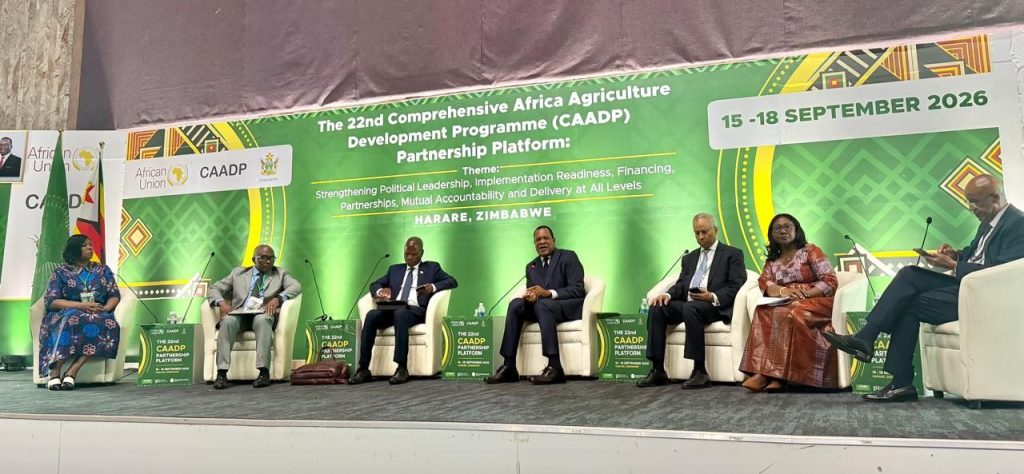
Zimbabwe’s Minister of Agriculture, Mechanization and Water Resources Development, Dr. Anxious Masuka, cited investments in irrigation and agricultural infrastructure as key drivers of increased production.
He noted that Zimbabwe’s wheat production rose from approximately 94,000 tonnes in 2018 and is projected to reach 700,000 tonnes by 2026. During that period, the area of land under irrigation expanded from 171,000 hectares to 305,121 hectares, with the private sector accounting for nearly 82% of this expansion, according to Minister Masuka.
Dr. Masuka stated that governments should invest in areas that have not yet reached a level capable of attracting private sector investment, while simultaneously creating an enabling environment for private sector investment.
He also highlighted resource constraints as a major challenge in implementing large-scale agricultural programs.
Eswatini’s Minister of Agriculture, Mandla Tshawuka, discussed the implementation of the Kampala Declaration, which calls for collaboration between the public sector and the citizenry.
He identified climate change as a significant threat to agricultural productivity and called for increased investment in irrigation and climate-resilient technologies.
He also emphasized the importance of supporting youth, women, and people with disabilities through targeted mechanisms to access agricultural financing, including the Eswatini Agricultural Development Fund.
Development partners call for projects capable of attracting investment
Representatives from the World Bank, AUDA-NEPAD, and the Food and Agriculture Organization (FAO) emphasized the need to translate Africa's commitments into concrete programs implemented at the national level.
The World Bank highlighted initiatives such as Agri Connect and Food System Climate Action Plans, which aim to foster projects capable of attracting investment.
AUDA-NEPAD stated that countries should adopt implementation plans rooted in national priorities, rather than relying on a "one-size-fits-all" approach for the entire continent.
The FAO outlined five key elements for successful program implementation: policy planning, domestic resource mobilization, inter-sectoral collaboration, robust agricultural data systems, and goal-oriented partnerships.
It also stressed that governments must focus on the return on investment in agriculture, particularly as nations face financial constraints and the escalating impacts of climate change.
The African Food Systems Parliamentary Network (ASPAN) called on legislatures to play an active role in transforming the agricultural sector. The representative of this group urged Members of Parliament to strengthen budget oversight, monitor the use of public funds, and promote good governance within sectors covered by food security programs.
The group also emphasized the importance of helping citizens understand how agricultural policies impact their livelihoods and assets.
The CAADP Partnership Platform will continue in Harare until September 18, 2026, bringing together government officials, development partners, the private sector, farmers' organizations, and other stakeholders.
The discussions are focused on how African countries can translate the Kampala Declaration into concrete action on food security, climate resilience and agricultural development.
Source: African Institutions Support Group