
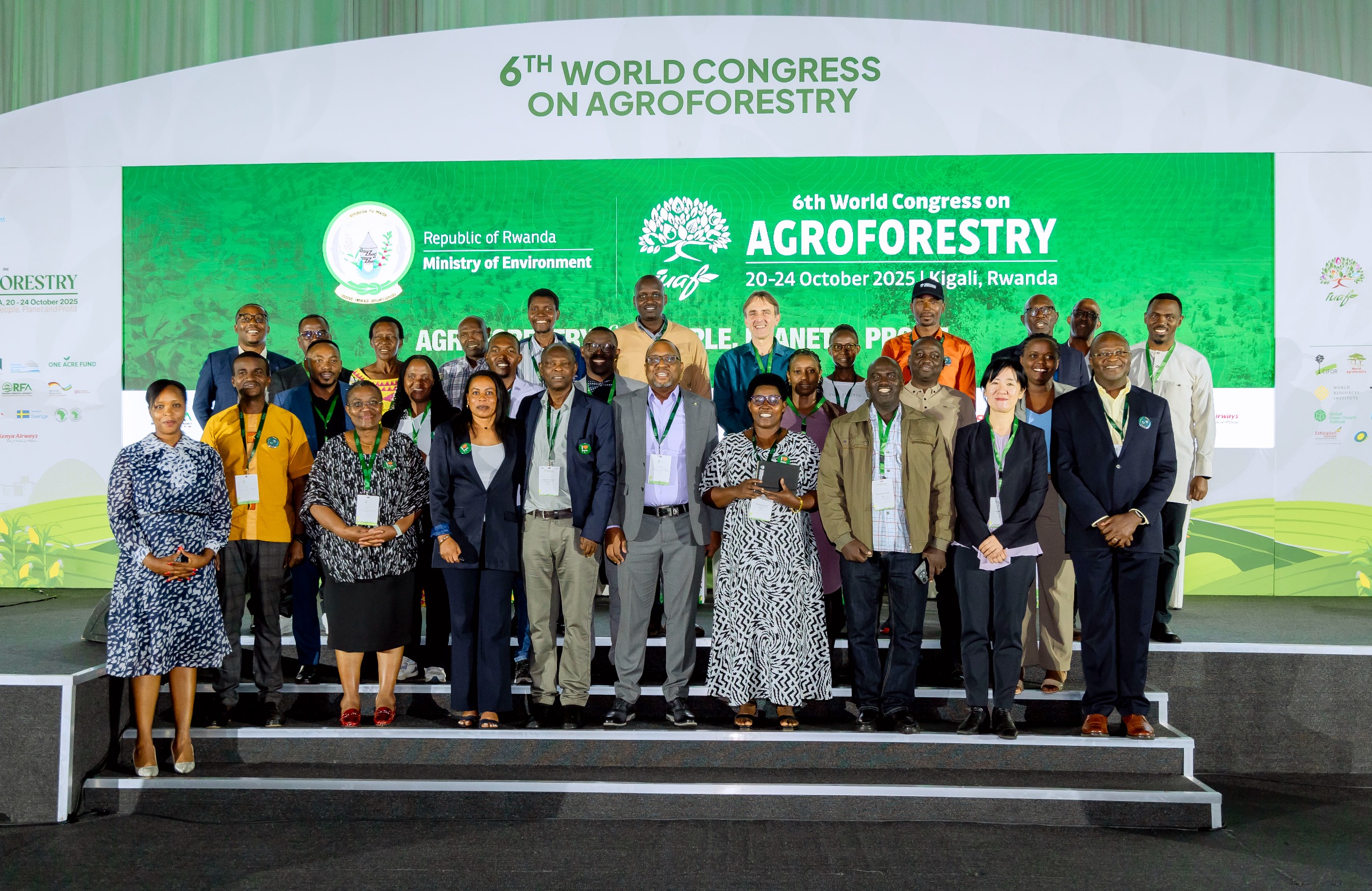
At the ongoing 6th World Congress on Agroforestry (#WCA2025) in Kigali, IUCN Rwanda hosted a session under the TREPA Project on “Integrated Landscape Approach for Sustainable Restoration for Improved Livelihood and Towards Climate-Resilient Communities.”

Dr. Olivier Habimana, who is the TREPA Project Coordinator, said that much had been done about the project within the restoration targets:
Initially, the project had set a target for 40,000 hectares of farmland restoration. As of now, we have already reached between 28,000 and 30,000 hectares. For pasturelands, the target was 10,000 hectares; we have already achieved approximately 7,000 hectares, meaning we have reached almost 70% of the overall tree planting targets.
Survival rates of fodder tree species are encouraging, with 85% for Gliricidia sepium and 75% for Calliandra calothyrsus. A total of 17.8 million seedlings, both native and non-native, have been planted, in addition to 289,339 fruit trees distributed to 72,334 households.
So far, 236,695 beneficiaries have adopted diversified, climate-resilient practices for their livelihoods.
Presently, about 60% of the budget is allocated to agroforestry, integrating trees with crops, and about 20% of the latter is already disbursed.
With less than two years remaining before the end of the project and around three planting seasons left to us, we are confident that we will meet or exceed our targets,” he said.
Beneficiaries from the TREPA Project narrated inspiring testimonies about how the initiative is transforming livelihoods and landscapes across Rwanda.

Bagiraneza Josephine, head of the Akagera Beekeepers Union, a network of six cooperatives in Rwinkwavu Sector, Kayonza District, spoke about the project in positively about the beekeeping sector:
“TREPA has exceedingly helped us by supplying trees which are now flowering and offering nectar for our bees to make honey in large quantities. It also provided us with the required beekeeping tools, mentorship, and learning visits, which help us build our capabilities,” she revealed.

From Nyagatare District, Livingstone Abiyingoma noted concerning dairy farming in Karangazi Sector that TREPA has really enhanced and increased livestock productivity: “Through the project, we learned how to grow and preserve fodder, and we planted trees like Calliandra that have increased our milk yield. This knowledge helps us sustain production even during dry seasons.”

IUCN Rwanda Country Representative, Ms. Kaori Yasuda, in her closing remarks at today’s session under the TREPA Project on “Integrated Landscape Approach for Sustainable Restoration for Improved Livelihood and Towards Climate-Resilient Communities” during #WCA2025, emphasized that true restoration begins with people, local communities, and farmers at the heart of change.
Together with the Government of Rwanda and partners, she highlighted how collaboration, financial inclusion, and participatory planning are driving effective restoration efforts on the ground. She reaffirmed the call to scale what works, strengthen community enterprises, and ensure transparency to sustain both nature and people.

During the congress, Equity Bank Plc showed its continued support for environmental protection by signing an agreement (MoU) with the TREPA Project.
“We’ve committed to ensuring that 30% of our total lending supports agriculture,” said Hannington Namara, Managing Director of Equity Bank Rwanda. “But we can’t achieve that alone Through this partnership, we aim to address the risks posed by climate change in Eastern province.”
TREPA is short for Transforming the Eastern Province through Adaptation. It is basically a national project initiated by the Government of Rwanda and implemented in collaboration with international partners like the International Union for Conservation of Nature (IUCN), GCF, the Ministry of Environment (MoE), and some other development partners: CIFOR-ICRAF, Cordaid, RFA, and World Vision.

This six-year project extends into the year 2027, and its overall goal is to transform degraded landscapes into resilient landscapes and fragile livelihoods into sustainable ones.
Geographical location: Kirehe, Ngoma, Bugesera, Rwamagana, Kayonza, Giatsibo and Nyagatare Districts of the Eastern Province.
Written By: Jean Bernard MUKUNDENTE