
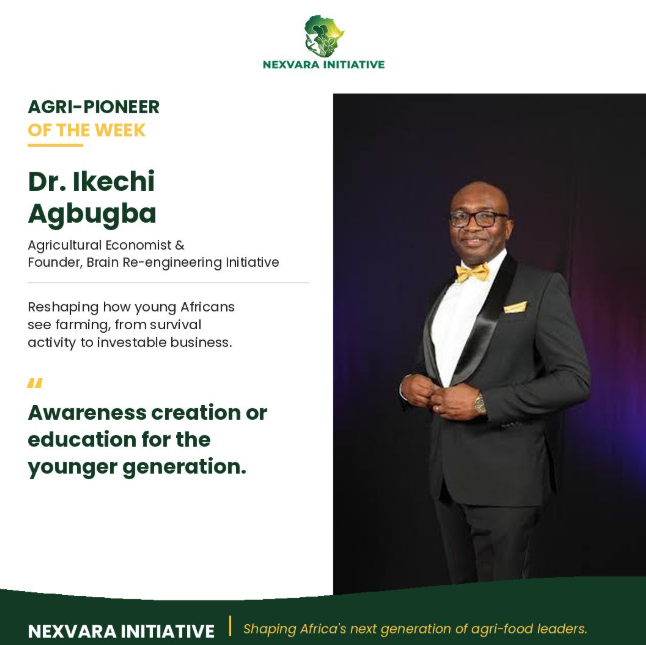
According to Dr Ikechi Agbugba, changing the perceptions of young people about agriculture, adopting modern technology and sharing the benefits of agricultural products are the effective solutions to Africa's agricultural development and problems of food security.
A great number of young Africans are in search of jobs in various fields, while the area of agriculture and agribusiness still remains unnoticed by many youngsters who do not consider this industry as a suitable sphere for employment.
Nigerian scientist and academic Dr Ikechi Agbugba explains that agriculture is not limited by land and resources. Instead, Africa's problem is that the young generation associates farming with hard physical work, poverty and suffering.
Agbugba aims to change this attitude with the Brain Re-engineering Initiative (BRI), aimed at changing the minds of young people who should realise that farming is a business.
"As young people in Rwanda and Nigeria understand, agriculture is a survival skill and punishment for those without job possibilities. We need to change this thinking and show them that agriculture is a modern profitable business," he said.
Abguga mentions that agriculture cannot any longer be viewed as a process based solely on the use of traditional tools, as new technologies and knowledge can make it a modern industry.
Changing Attitudes Before Technology Implementation
Dr Ikechi Agbugba believes that the BRI project is set to change attitudes, come up with business ideas, introduce technologies, and provide equal opportunities in agriculture.
Dr Ikechi Agbugba believes that the youth should advance further from thinking of merely cultivation to exploring processing, value chains, marketing, and building successful agricultural businesses.
In the case of Rwanda, he points out that he has noticed the contrast between the technology-using economy, as it seems that some types of agricultural activities have still remained in the era of manual tools.
Dr Agbugba specifies that his interest in agriculture in Rwanda originated from his activity in the Africa Organization of Technology in Agriculture (AOTA), with which he is involved in cooperation with the University of Rwanda and the Ministry of Agriculture and Animal Resources.
He emphasised the role he played in the organisation of the International Conference on Business Models in Agriculture (IBMA), which has been conducted in several sessions in Kigali, including one in South Africa.
The primary focus of this event is to determine the business models that could make agriculture lucrative and appealing to the youth.
Farmers Do Not Need to Be Affluent to Utilise Technology
Although agriculture technology is usually associated with high investment, Agbugba believes that it is possible to make it affordable for small-scale farmers who cannot pay for expensive machinery.
He mentions the concept of shared machinery and equipment services as one of the possibilities. This would give farmers an opportunity to pay for agricultural services without purchasing tractors and drones on their own.
This concept works even for the farmers who own very small parcels of land.
Technology
One more solution is to adopt technologies that do not rely on uninterrupted access to the Internet or electricity.
Several different solutions use simple technology; for example, some services can be provided using mobile phones.
"Technologies should be developed based on our environment and resources and not wait for the entire infrastructure to be available. Farmers do not need to own every machine in order to benefit from its services," he offered.
Conceptualising Access to Financial Resources for Young Farmers
Referring to access to finance issues, Agbugba mentions that some agricultural loan programmes have not been successful because of the way funds are distributed and monitored.
He believes that disbursing funds with no follow-up may lead to fraudulent activities.
In his suggested approach, money given to young farmers would not be transferred to them in cash but transferred directly to the suppliers of means of production, seeds, and services.
He proposes to tie loans to arrangements where factories or other consumers buy farmers' products. The profits from sales would be used for paying off the loans.
He believes that such an approach can mitigate risks both for farmers and lenders, with the monitoring of projects and expenditures being a critical aspect of success.
Women Should Have Access to Agricultural Opportunities
According to Dr Ikechi Agbugba, the encouragement of women's participation in agriculture should not be restricted to simply providing them with money or farming equipment but should also involve approaches that take local cultures and living conditions into consideration. He cited a variety of agricultural business opportunities near home, including processing of groundnut oil, shea butter production and solar drying of vegetables. He believes that rather than being considered as impediments that hinder change, family heads, and leaders in the church and community should be actively involved in such initiatives. "We should not just apply Western farming methods and practices in our communities without taking the culture of people into consideration," he argued.
Africa should not just focus on primary agricultural exports; rather, it should emphasise processing agricultural produce before they get exported, and this is what Agbugba firmly believes.
He mentions varieties like cashew, ginger or sesame, whose popularity can also be increased by getting access to international market segments through proper processing.
As a good example, Agbugba states that cassava that gets processed into starch for the production of industrial products and maize and rice can help reduce the amount of imports.
In the realm of fruit and vegetables, Agbugba suggests greenhouse cultivation of tomatoes and sweet pepper as the means of ensuring relatively quick production and supply to urban areas.
He proposes that the more young people focus on processing rather than producing, the higher the chances of getting additional income for themselves there would be.
Launching the Programme in Two States of Nigeria
Dr Ikechi Agbugba, states that he intends to launch the programme in Nigeria and that Ogun State in Nigeria's southwest and Kaduna State in the northwest have been chosen as its starting points.
According to him, since Ogun State is located close to Lagos, which is an urban centre, its selection was primarily based on this geographical proximity. Kaduna State will offer agricultural pasture and a long farming tradition.
In order for this program to be successful, he says that the cooperation between the public and private sectors of the economy must be perfect, presenting convenient opportunities for youth entrepreneurs and bringing them together with other business organizations.
He states that the idea is not just to obtain funds, but to make investments in youth enterprises and establish efficient cooperation between producers and customers.
“You do not need to travel to other countries or pack your bags to benefit from foreign money,” he said. He adds that modern technology, marketing and innovations are the solutions for young people who wish to succeed in agricultural production and commerce.
About the expert

Associate Professor Ikechi Kelechi Agbugba is a Nigerian agricultural economist and the pioneer of the Brain Re-Engineering Initiative (BRI), which seeks to change how young people perceive and engage in agriculture.
He is a co-founder of the Africa Organisation of Technology in Agriculture (AOTA) and chairs the International Conference on Business Models in Agriculture. He is based at Rivers State University in Nigeria and has held academic and research positions at institutions in the UK and South Africa.
His work has involved collaborations with international organisations, including the World Bank, FAO, USAID and WorldFish, focusing on food security, agricultural markets and rural development. He has also helped establish academic partnerships between Nigerian institutions, AOTA and the University of Rwanda.
Through his research and advocacy, Dr Agbugba promotes a shift towards a more innovative, commercially driven and inclusive agricultural sector in Africa.
Written By Jean Bernard MUKUNDENTE